
TL;DR
Collections calls should be categorised by why the customer fell behind, not only by the outcome a wrap-up code records. The reason determines whether a payment plan will hold, and CCD2, which applies from 20 November 2026, asks lenders to show reasonable forbearance and to detect difficulty early. Belgian consumer-credit arrears rose 4.9% year on year (April 2024), French over-indebtedness filings rose 9.8% in 2025, and at StepChange no single main reason for debt exceeds 18% of cases. This guide covers the data, what CCD2 expects, a three-layer taxonomy (reason, capacity, outcome) and what to measure once reasons are captured.
Ask a collections team why customers fall behind and you will get a good answer. Ask the system and you will get a wrap-up code: promise to pay, refused, callback. The code records the outcome of the call. The reason, the thing that determines whether a payment plan will hold, stays in the conversation.
That gap is about to matter more. The new EU Consumer Credit Directive requires lenders to show forbearance and to detect customers in difficulty early, and arrears figures in Belgium and France are moving the wrong way.
Key figures
| Figure | Value | Source |
|---|---|---|
| Belgian borrowers with at least one overdue credit (Apr 2024) | 264,655 | National Bank of Belgium, CICR |
| Share of Belgian borrowers in default | 4.3% | NBB, CICR |
| Year-on-year change in Belgian consumer-credit arrears (Apr 2024) | +4.9% | NBB, CICR |
| Over-indebtedness files submitted in France, 2025 | 148,013 (+9.8%) | Banque de France |
| Distinct main reasons for debt recorded by a UK debt charity | 10 categories, none above 18% | StepChange Statistics Yearbook 2025 |
| CCD2 application date | 20 November 2026 | Directive (EU) 2023/2225 |
1. Arrears are rising, and they are not one problem
Belgium
The National Bank of Belgium's credit register counted 264,655 borrowers with at least one overdue credit in April 2024, or 4.3% of borrowers, with €2.22bn in arrears. The number of borrowers in default fell slightly (−1.8%), but the amounts in arrears rose (+3.7%), and faster still for consumer credit (+4.9%). Fewer people, deeper difficulty.
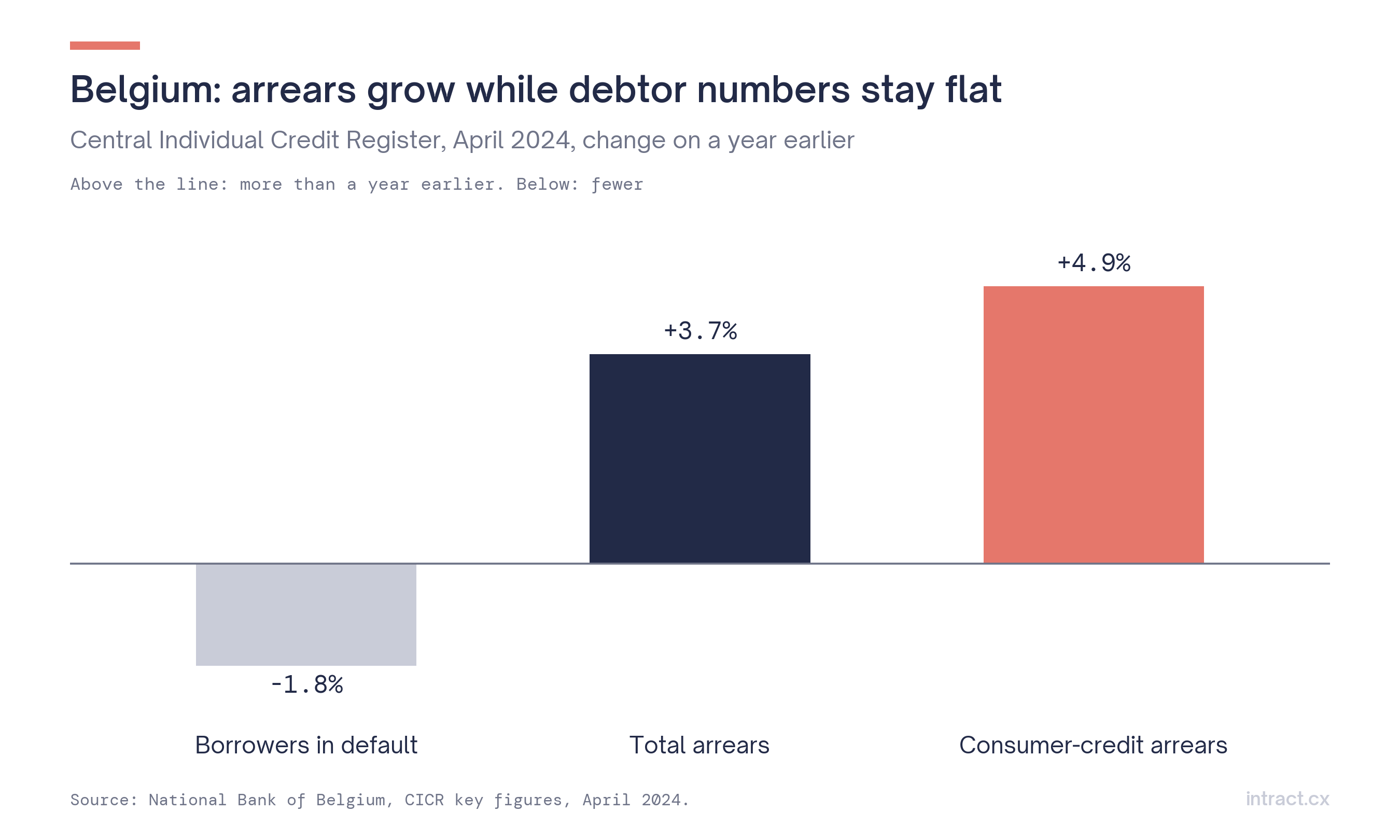 Figure 1. Belgium, April 2024: debtor count flat, arrears up.
A note on bases: you will also see "2.3–2.6%" quoted for Belgium. That figure is a share of the whole population, not of borrowers. Always state which base you use.
France
Filings with the Banque de France over-indebtedness commissions reached 148,013 in 2025, up 9.8%, after a 10.8% rise in 2024. Levels remain well below 2014, but the trend has turned. Consumer credit represents 44% of the debt of over-indebted households.
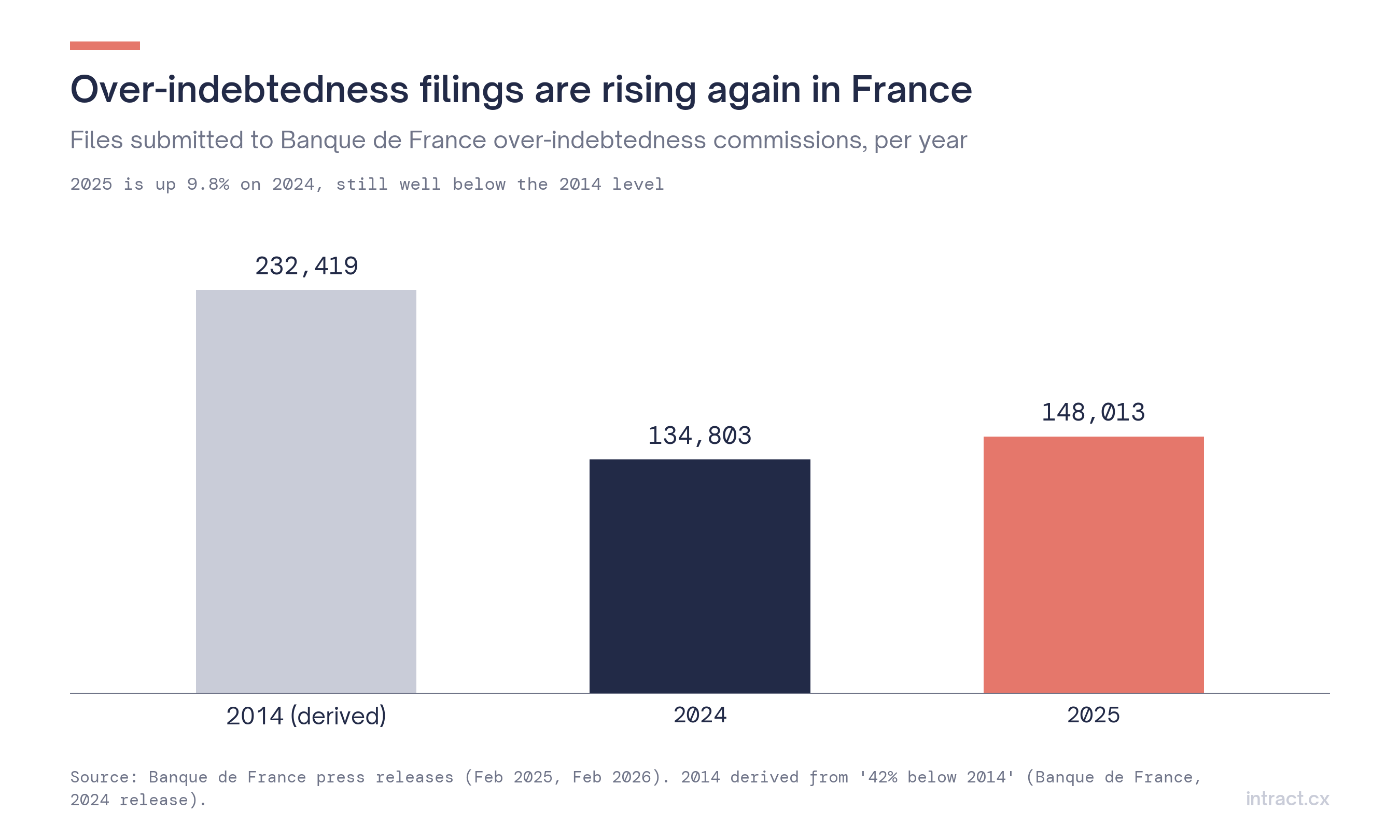 Figure 2. Over-indebtedness filings, France. 2014 is derived from the Banque de France statement that 2024 was 42% below 2014.
2. Why people fall behind: the data
The best public breakdown of reasons comes from StepChange, the UK debt charity, which records the main reason for debt for every new client. In 2025, across 163,916 new clients:
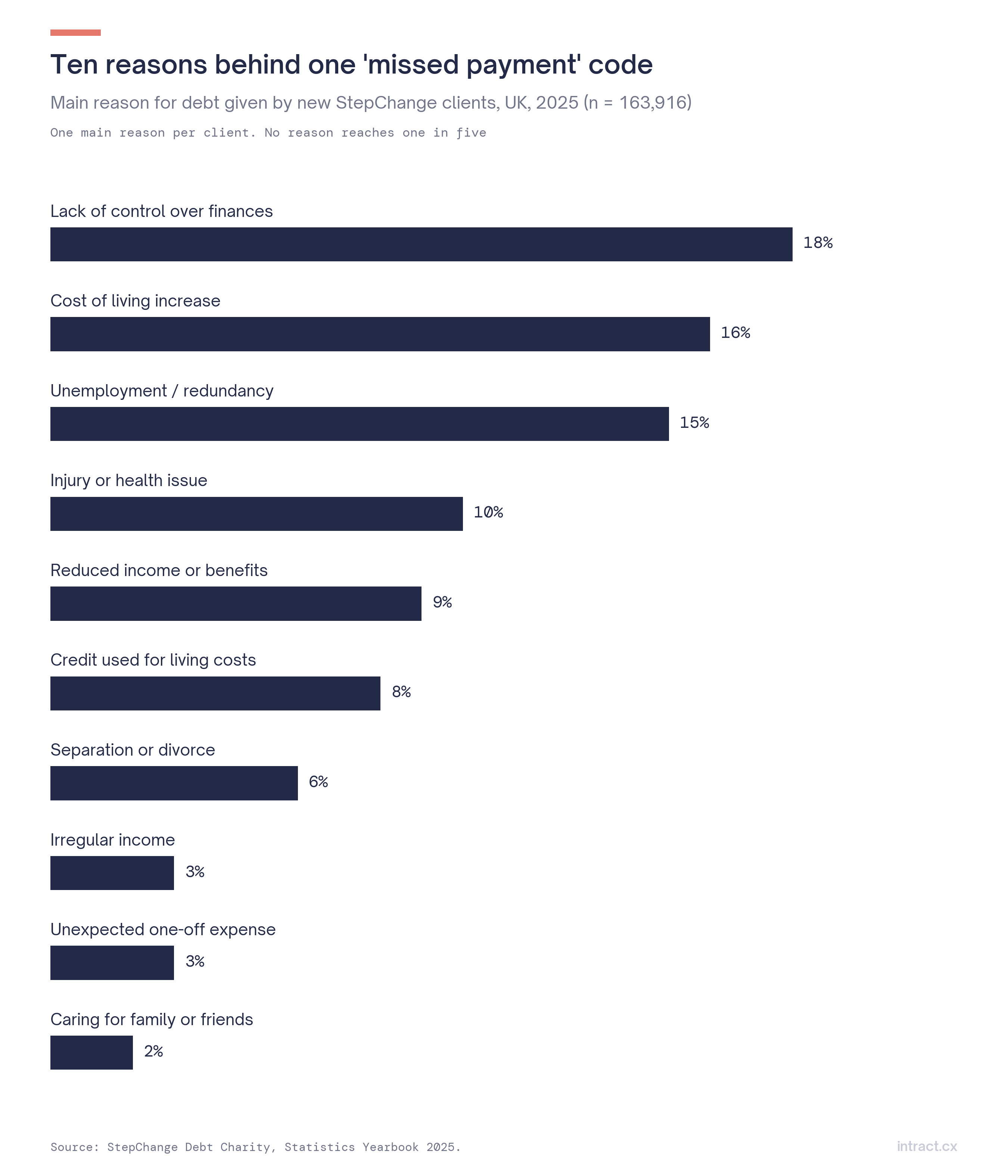 Figure 3. No single reason accounts for more than 18% of cases.
| Main reason | Share |
|---|---|
| Lack of control over finances | 18% |
| Cost of living increase | 16% |
| Unemployment or redundancy | 15% |
| Injury or health issue | 10% |
| Reduced income or benefits | 9% |
| Need credit to cover living costs | 8% |
| Separation or divorce | 6% |
| Irregular income | 3% |
| Unexpected one-off expense | 3% |
| Caring for family or friends | 2% |
The Banque de France's 2025 typology of over-indebtedness points the same way: life events such as job loss, separation and illness far outweigh pure budget-management issues. Among over-indebted households, 26% are unemployed or seeking work, 24% divorced or separated, and 21% single-parent families. Half say their difficulties began more than two years earlier.
Each of these reasons calls for a different response. A customer who forgot a direct debit needs a reminder. A customer recently made redundant needs a payment holiday or a restructuring. A customer with a health issue may be vulnerable and need specific handling. One wrap-up code cannot carry that.
3. What the regulation now expects
The Consumer Credit Directive (EU) 2023/2225, known as CCD2, applies from 20 November 2026. Two articles bear directly on collections calls:
- Article 35: creditors must, where appropriate, show reasonable forbearance before enforcement, taking the consumer's circumstances into account. Listed measures include extending the term, deferring payments, reducing the rate, partial repayment and consolidation.
- Article 36: creditors must have processes for the early detection of consumers in financial difficulty, and refer them to debt advice services.
"Taking circumstances into account" and "early detection" both require knowing why the customer is behind. The UK offers a preview: when the FCA reviewed lenders' treatment of borrowers in difficulty, it found that most firms did not consistently identify the needs of vulnerable customers, and it wrote to more than 3,500 lenders. The FCA's own survey finds that 49% of UK adults showed characteristics of vulnerability in 2024.
4. A taxonomy for collections calls
A practical structure has three layers: the reason (why), the capacity (can they pay, and when), and the outcome (what was agreed). Wrap-up codes usually only capture the third.
| Reason (level 1) | Sub-reason (level 2) | Signal to listen for | Typical next step |
|---|---|---|---|
| Income shock | Job loss, reduced hours, end of contract | "I lost my job", "my contract ended" | Payment holiday, term extension |
| Health | Illness, accident, disability | "I've been in hospital", "on sick leave" | Vulnerability flag, specialist handling |
| Household change | Separation, death, new dependant | "since the divorce", "my partner left" | Restructuring, debt advice referral |
| Cost of living | Energy, rent, food | "everything's gone up" | Budget review, affordable plan |
| Multiple debts | Other creditors, consolidation | "I have other loans", "other lenders calling" | Debt advice referral (CCD2 Art. 36) |
| Administrative | Forgotten debit, bank change, address | "I changed bank", "didn't get the letter" | Fix the mandate, no escalation |
| Dispute | Contests amount, product, fraud claim | "I never signed", "this isn't right" | Route to complaints / fraud |
| Unwilling | Refuses without stated reason | "I'm not paying" | Standard recovery path |
Add two cross-cutting flags: vulnerability (health, bereavement, distress, difficulty understanding) and promise quality (concrete date and amount vs vague intention).
Two rules make the taxonomy usable:
- Keep level 1 short (6–8 values) so it can be trended and charted.
- Store the customer's words with each label. A reviewer, an auditor or a manager should be able to check any classification in seconds.
5. What you can measure once reasons are captured
- Reason mix over time: is "income shock" rising after a local plant closure? Is "administrative" spiking after a direct-debit migration?
- Promise-kept rate by reason: plans agreed with customers facing an income shock may break more often than those for administrative misses.
- Forbearance offered vs reason: evidence for CCD2 Art. 35 that measures matched circumstances.
- Referral rate to debt advice for customers with multiple debts, for Art. 36.
- Disputes and complaints hidden in collections calls, which should not stay in the collections queue.
How Intract supports this
Intract transcribes and analyses every collections call it receives (natively from Aircall or Vonage, or through its API). An AI classifier in a no-code workflow assigns a reason and sub-reason from your own taxonomy, with labels and training examples, and writes them as two columns on each call. You test the classification on recent calls and mark each answer right or wrong to get an accuracy score per column before publishing. Each interaction also carries a summary, business impact, sentiment, urgency, churn risk and an action plan. Dashboards show the reason mix by team and period, and a Teams alert can notify a supervisor when, for example, a dispute or a vulnerability signal is detected.
In a pilot with a European consumer-credit lender, collections calls were categorised by reason and sub-reason on every call.
Intract works alongside your collections system: it adds the why next to the codes you already use.
FAQ
Should we replace our wrap-up codes? No. Keep outcome codes for workflow. Add the reason alongside them, captured from the conversation.
How many reason categories is right? Six to eight at level 1, with sub-reasons underneath. More than that becomes hard to trend.
Does this help with CCD2? It supports the evidence: why each customer was behind, what was offered, and whether difficulty was detected early. Your legal team decides what your national transposition requires.
Methodology and sources
All figures come from the sources below. Belgian data are the latest NBB monthly figures we could access (April 2024); more recent sheets exist. The 2014 French figure is derived (134,803 / 0.58). The taxonomy is an Intract proposal informed by the StepChange and Banque de France categories.
- National Bank of Belgium, CICR key figures, April 2024
- Banque de France, press releases Feb 2026 and 2025; Typologie du surendettement 2025
- StepChange, Statistics Yearbook 2025
- Directive (EU) 2023/2225, EUR-Lex; Art. 35, Art. 36
- FCA, Financial Lives 2024 key findings; Forvis Mazars, FCA reminds lenders to support consumers